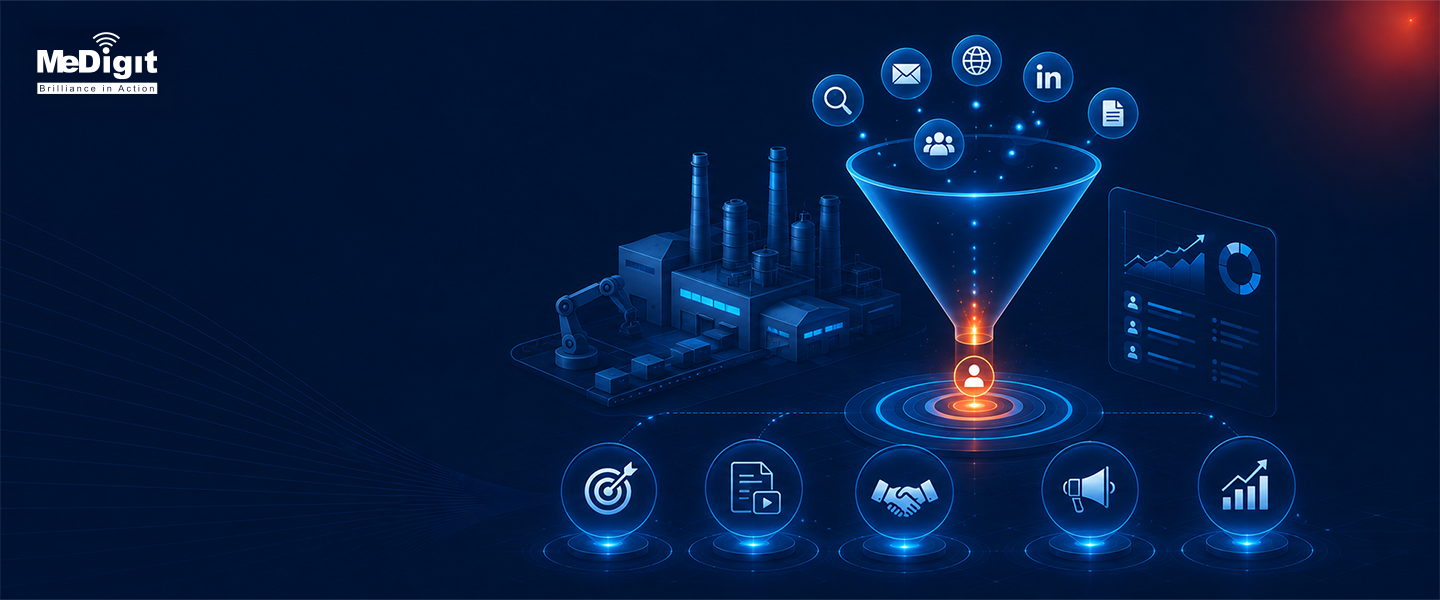
Manufacturers don’t necessarily need more leads. They need more qualified leads—prospects with a genuine requirement, the right company profile, buying intent, and a realistic path to becoming customers.
If your sales team is spending time filtering out students, irrelevant businesses, low-budget inquiries, or prospects with no immediate requirement, your lead generation strategy may be optimized for volume instead of intent.
Here are five high-intent lead generation tactics manufacturers can use to improve lead quality and build a stronger B2B pipeline.
1. Target High-Intent Search Queries
Broad keywords such as “industrial equipment” or “manufacturing solutions” can generate traffic but often attract users who are only researching.
Instead, target commercial-intent keywords that indicate a specific requirement.
For example:
- Industrial equipment supplier
- CNC machine manufacturer for automotive
- Industrial automation supplier in India
- Custom packaging manufacturer
- Industrial filtration system supplier
The more specific the search query, the easier it becomes to connect the prospect with the right solution.
Action: Build keyword groups around product + application + industry + location, and prioritize queries showing supplier, pricing, quotation, or solution-seeking intent.
2. Create Problem-Specific Landing Pages
Sending every visitor to a generic “Contact Us” page makes it difficult to understand their actual requirement.
Create dedicated landing pages for specific:
- Industries
- Products
- Applications
- Business problems
- Use cases
For example, an industrial automation company could create separate pages for automotive manufacturing, pharmaceutical manufacturing, and food processing.
Include qualification signals such as industries served, minimum order requirements, technical capabilities, certifications, project size, and locations served.
Your form can also capture useful information such as:
Company → Industry → Requirement → Project Timeline → Location
This helps filter poor-fit inquiries before they reach sales.
3. Use Account-Based Targeting for High-Value Prospects
If your average manufacturing deal is valuable, you don’t need thousands of random leads.
You need the right companies.
Account-Based Marketing (ABM) allows manufacturers to identify and target companies that closely match their Ideal Customer Profile (ICP).
Define target accounts using factors such as:
- Industry
- Company size
- Geography
- Revenue
- Manufacturing capacity
- Product requirements
- Technology used
Then create content and campaigns specifically around their challenges.
For example, instead of targeting “automotive companies,” target automotive Tier-1 suppliers looking to improve production efficiency.
This makes marketing more relevant and gives sales a clearer list of accounts to prioritize.
4. Create Content Around Buying Intent
Manufacturing content shouldn’t only answer basic educational questions.
Create content that helps prospects evaluate suppliers and make purchasing decisions.
Examples include:
- How to Choose an Industrial Equipment Supplier
- Industrial Equipment Buying Checklist
- Questions to Ask Before Selecting a Manufacturing Partner
- How Much Does Industrial Automation Cost?
- OEM vs. Aftermarket Components: Which Is Better?
Match your CTA to the prospect’s buying stage.
Awareness: Download the guide
Evaluation: Compare your requirements
Decision: Request a technical consultation
Purchase: Request a quote
This turns content from a traffic-generation tool into a demand-generation asset.
5. Qualify and Score Leads Before Sales Follow-Up
Generating qualified traffic is only half the job.
You also need a system to determine which leads deserve immediate sales attention.
Score leads based on:
- ICP/company fit
- Industry
- Requirement
- Project timeline
- Engagement
- Product-page visits
- Quote requests
- Technical consultation requests
For example, a prospect that matches your target industry, has an active requirement, and requests a quotation should receive a much higher priority than someone who only downloaded an introductory guide.
The goal is simple:
Don’t send every lead to sales. Send sales the leads most likely to become opportunities.
Build a Lead Generation System, Not Just Campaigns
These tactics work best when connected:
Target the right accounts → Capture high-intent searches → Convert with relevant landing pages → Qualify leads → Prioritize sales opportunities → Measure pipeline and revenue
This requires marketing, conversion, qualification, and CRM processes to work as one system. MeDigit’s Growth Architecture Framework explains how businesses can connect these components into a scalable growth engine.
The key metric isn’t simply how many leads you generate.
It’s how many qualified opportunities those leads create.
Frequently Asked Questions
What is high-intent lead generation for manufacturers?
High-intent lead generation focuses on prospects actively researching, evaluating, or looking to purchase a manufacturing solution. It uses commercial search queries, targeted accounts, relevant landing pages, and buying signals to attract prospects with a stronger likelihood of becoming sales opportunities.
How can manufacturers generate more qualified leads?
Manufacturers can improve lead quality by targeting commercial-intent keywords, creating industry-specific landing pages, using account-based marketing, publishing decision-stage content, and implementing lead qualification. The strategy should focus on attracting companies that match the ideal customer profile rather than maximizing total form submissions.
How do you identify high-intent B2B leads?
High-intent B2B leads typically show both company fit and buying behavior. Examples include requesting a quote, visiting product or pricing pages, submitting a technical inquiry, downloading product specifications, or actively searching for suppliers. Combining these signals with ICP criteria helps sales teams prioritize the strongest opportunities.
Why are manufacturers getting unqualified leads?
Unqualified leads often come from broad targeting, generic keywords, weak landing-page messaging, or campaigns optimized only for lead volume. Manufacturers can improve quality by narrowing their audience, targeting specific commercial intent, adding qualification fields, and using lead scoring before sending prospects to sales.
What is the best lead generation strategy for manufacturers?
The right strategy depends on the manufacturer’s product, market, deal size, and sales cycle. In most B2B manufacturing markets, a combination of high-intent SEO, targeted landing pages, account-based marketing, decision-stage content, and lead qualification can create a stronger and more predictable pipeline.
What is the difference between lead volume and qualified pipeline?
Lead volume measures the number of contacts generated. Qualified pipeline measures the potential sales value represented by prospects that fit your target customer profile and demonstrate genuine buying intent. For manufacturers, a qualified pipeline is usually a more meaningful growth metric than raw lead volume.
Ready to Move Beyond Unqualified Leads?
MeDigit helps businesses build predictable demand-generation systems that connect lead generation, qualification, conversion, and revenue.
Focus on generating the right leads—not just more leads.