Introduction
More campaigns do not always mean more growth.
A business can increase its marketing spend, add new channels and generate more traffic or leads—yet still struggle with rising CAC, weak conversion or inconsistent revenue.
The problem is often not the absence of marketing activity. It is the lack of alignment between the different parts of the growth system.
This is where a Growth Architecture Framework becomes useful. Instead of treating campaigns as isolated activities, it looks at the variables that influence growth and how they work together—from funnel stage and channel to value proposition, message, creative and landing experience.
The objective is simple: diagnose what is limiting growth, test the right variable and scale what works.
What Is a Growth Architecture Framework?
A Growth Architecture Framework is a structured way of designing, diagnosing and improving a growth system.
MeDigit’s model treats marketing outcomes as a function of controllable variables:
Business Outcome = f (Channel × Value Proposition × Message × Creative × Landing Page)
These variables operate within a defined funnel stage. The funnel establishes user intent, which then influences the decisions made across the other layers.
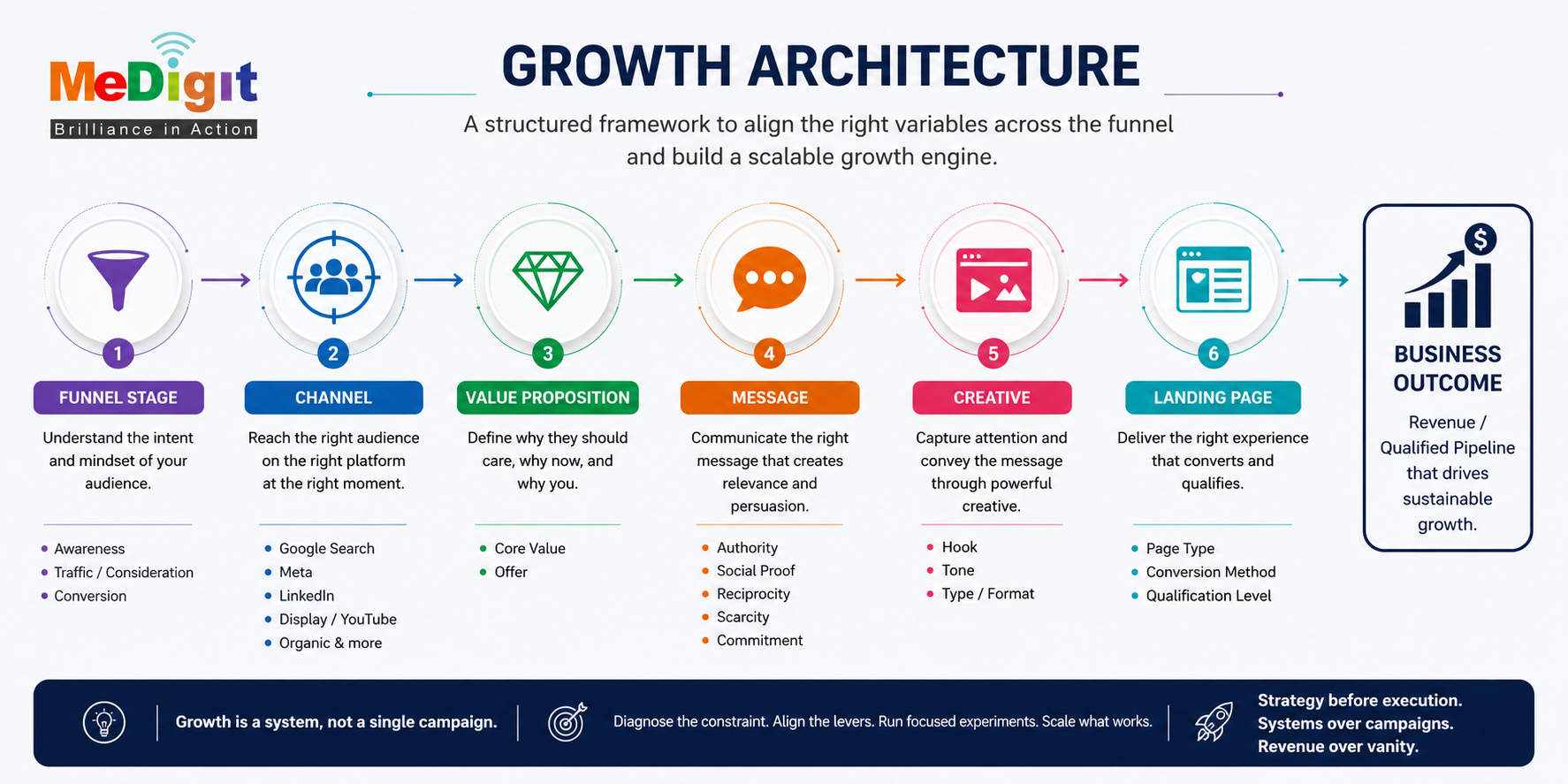
The important idea is that growth is not driven by one lever in isolation. Alignment drives performance.
The 6 Layers of Growth Architecture
1. Funnel Stage: Understand the Intent
Before deciding what to say or where to advertise, understand where the audience is in the funnel.
MeDigit’s simplified funnel includes:
- Awareness — the audience has no active intent; objective is attention.
- Traffic / Consideration — the audience is exploring solutions.
- Conversion — the audience is ready to take action.
Funnel stage matters because intent dictates downstream decisions. A message designed for someone discovering a problem should not be identical to one designed for someone ready to buy.
2. Channel: Reach the Right Audience
The channel determines where the audience is reached.
Depending on the objective, this could include:
- Google Search
- Meta
- LinkedIn
- Display
- YouTube
- Organic channels
But channel selection should not happen simply because a platform is popular.
Channel ≠ intent.
Intent is determined by the funnel stage and campaign objective.
3. Value Proposition: Give People a Reason to Care
The next question is:
Why should the customer care—and why should they act now?
MeDigit’s model separates value proposition into:
Core Value + Offer
Core value explains why the proposition matters. The offer provides a reason to act.
For example, a business may offer a solution that saves time, reduces cost, simplifies a process or reduces uncertainty. The offer then creates the immediate reason to engage.
Every campaign should therefore have a clear value proposition rather than simply promoting a product or service.
4. Message: Create the Psychological Trigger
The message is the psychological principle used to influence decision-making.
MeDigit’s framework draws on persuasion principles such as:
- Authority
- Social proof
- Reciprocity
- Scarcity
- Commitment and consistency
Importantly, message is not the same as creative.
Message defines the psychological trigger. Creative determines how that trigger is executed.
5. Creative: Turn the Message Into Attention
Creative is the execution layer that captures and holds attention.
MeDigit breaks creative into three components:
Hook + Tone + Type
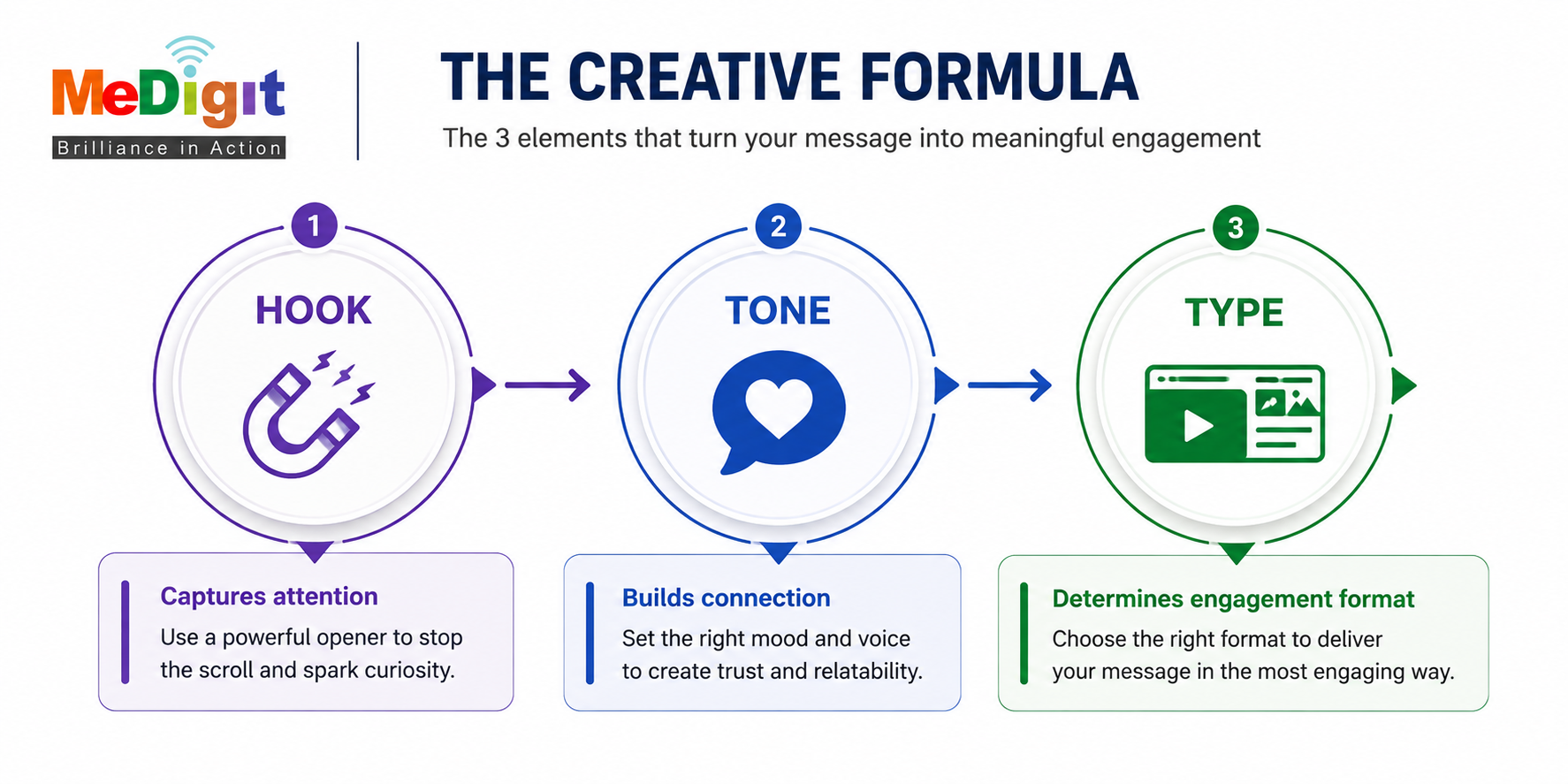
A hook could use a pain point, statistic, question, story or intrigue. Tone could be expert, logical, empathetic, premium or action-oriented. Formats could include UGC, product demos, expert videos, carousels or motion graphics.
6. Landing Page: Convert and Qualify
The final layer is the landing experience.
A landing page is not simply a design asset. In MeDigit’s model, it is a conversion system and signal-control mechanism.
It can be evaluated across:
- Page type: Generic, problem-specific or offer-specific
- Conversion method: Form, step form, call/WhatsApp or meeting booking
- Qualification level: Low, medium or high
The right landing experience depends on the audience, intent and business objective.
Why Alignment Matters More Than Individual Campaigns
Consider a business receiving plenty of website traffic but very few conversions.
The obvious reaction may be to change the advertising channel.
But the problem could actually be:
- Weak value proposition
- Poor message
- Irrelevant creative
- Poor landing experience
Similarly, high lead volume does not necessarily mean successful demand generation. If leads are not becoming SQLs, the problem may lie in targeting, messaging or qualification.
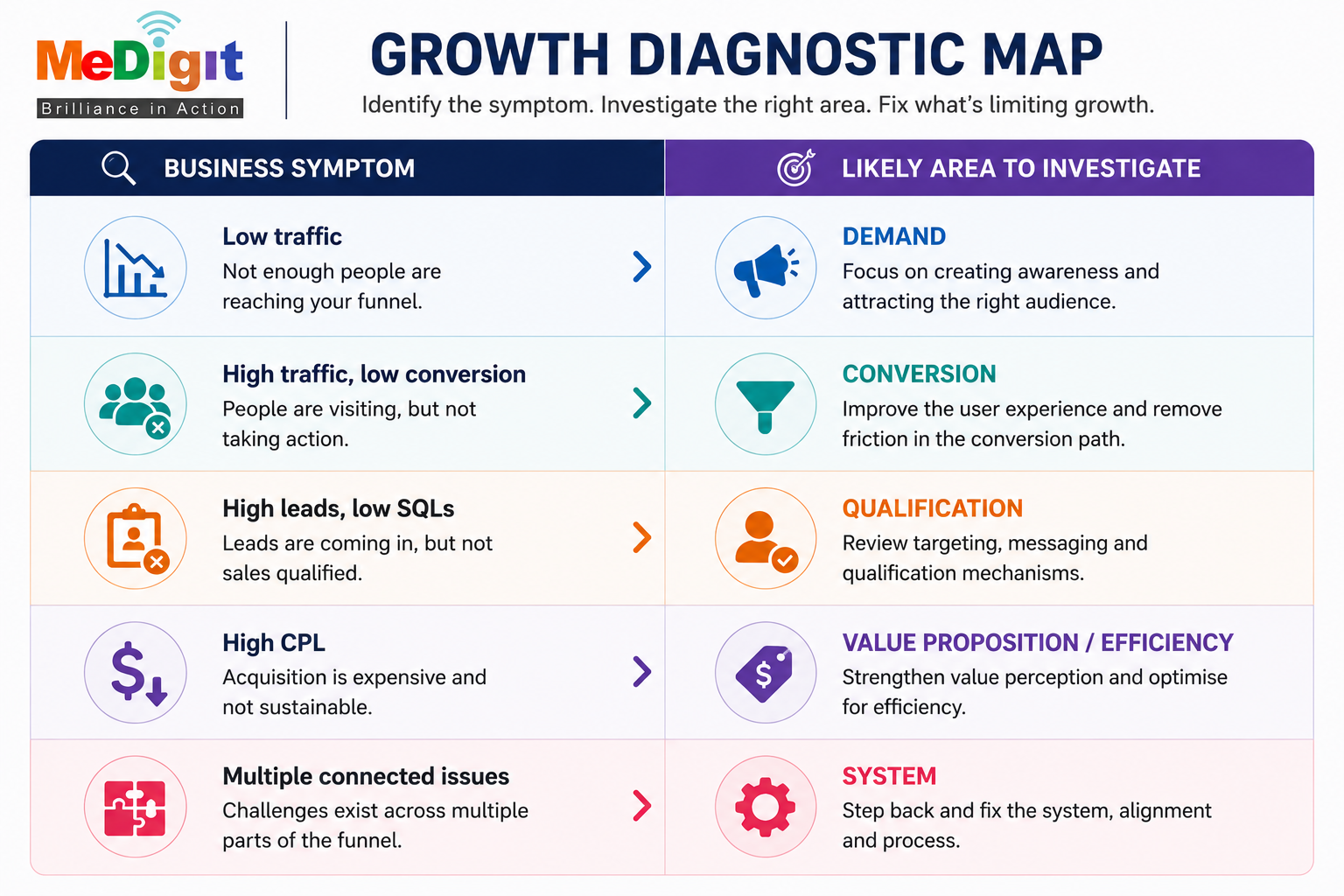
MeDigit’s diagnostic framework therefore classifies growth problems into five categories:
Demand → Conversion → Qualification → Efficiency → System
For example:
From Growth Architecture to Experimentation
Once the growth problem and relevant levers are identified, the next step is experimentation.
The MeDigit model follows:
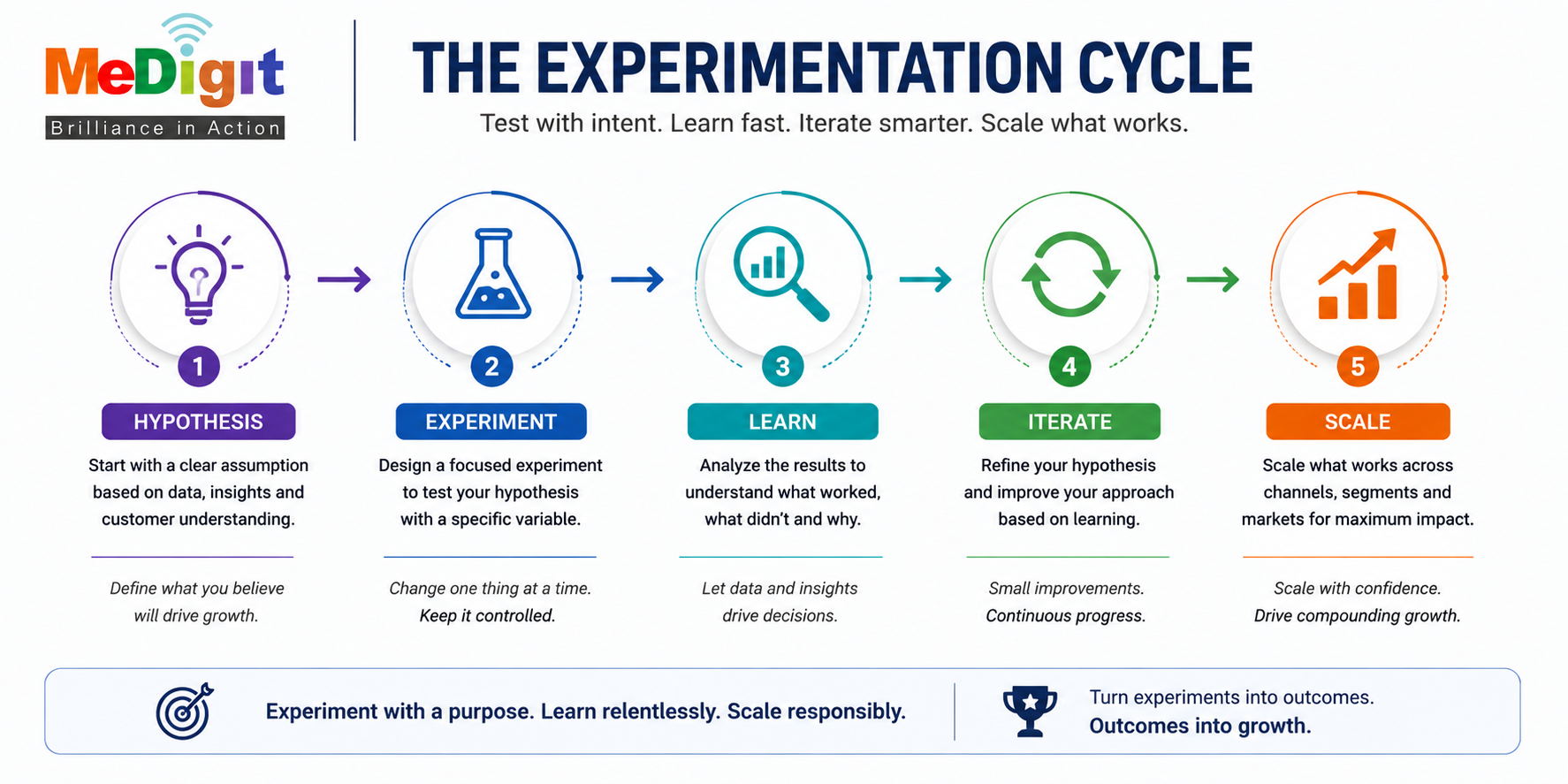
Each experiment should have:
- A variable being tested
- An expected outcome
- A reason or hypothesis
Experiments are prioritised using:
(Impact × Confidence) ÷ Effort
Impact considers the potential effect on revenue or SQLs. Effort considers time, cost and complexity. Confidence reflects the strength of available data or logic.
This prevents growth teams from falling into the trap of running random tests simply to “optimise” campaigns.
Building a Scalable Growth Engine
A scalable growth engine is created through a repeatable cycle:
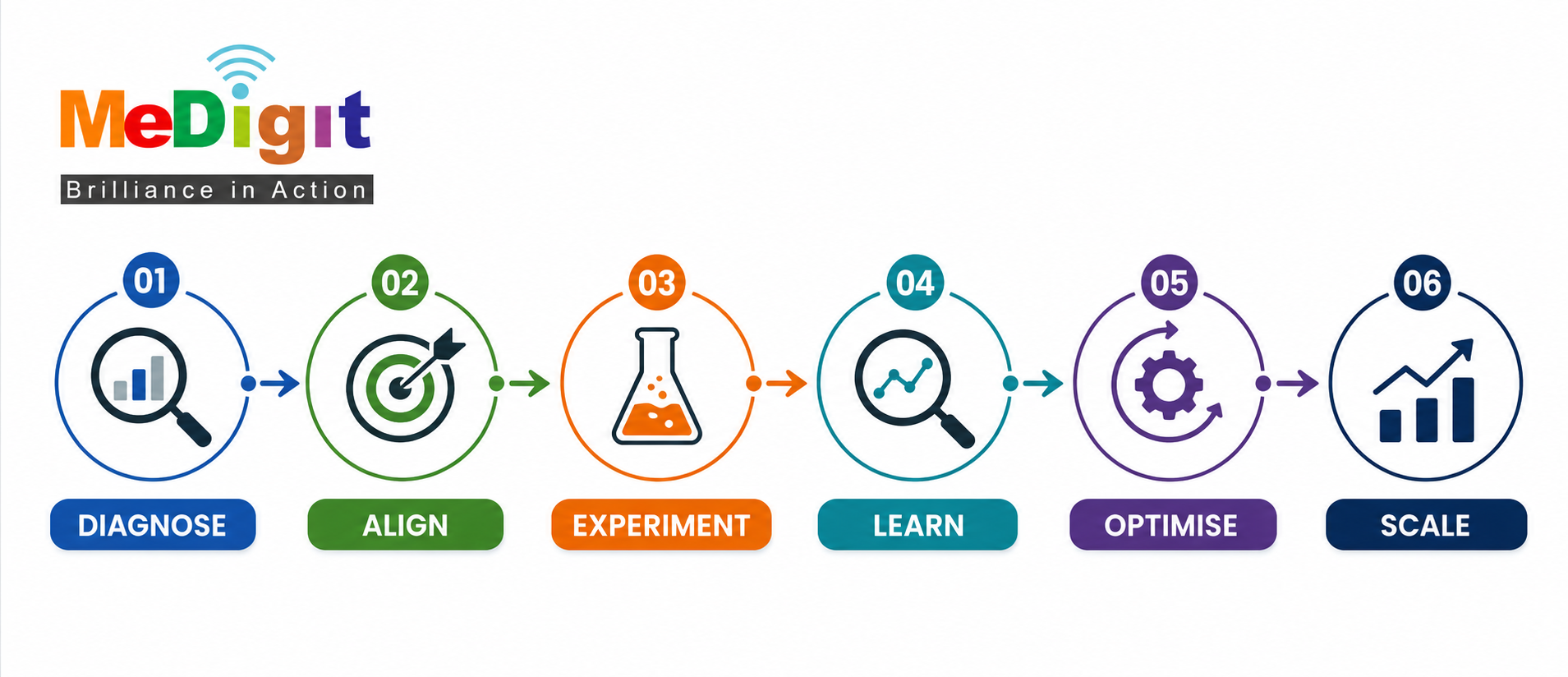
Scaling should happen only when conversion is stable, CAC is acceptable and the funnel has been validated.
This is fundamentally different from simply increasing budgets or adding more campaigns.
MeDigit’s operating principles capture the approach:
- Strategy before execution.
- Fewer, better experiments.
Growth Architecture Is About Making Growth Work Better
The biggest mistake businesses can make is treating every growth problem as a campaign problem.
Sometimes the problem is demand.
Sometimes it is conversion.
Sometimes it is lead quality.
And sometimes the issue is the system connecting everything together.
A Growth Architecture Framework provides a structured way to find that constraint, align the right growth levers, run controlled experiments and scale validated outcomes.
For revenue-led businesses, this thinking supports mRevX, MeDigit’s Revenue Growth System. For lead-driven businesses, it supports mDemandX, the Qualified Pipeline Growth System.
Growth is not about running more campaigns. It’s about building a system where the right audience, proposition, message, creative and conversion experience work together to produce a business outcome.
FAQ
What is a Growth Architecture Framework?
It is a structured framework for diagnosing and improving the variables that influence growth, including funnel stage, channel, value proposition, message, creative and landing experience.
How is Growth Architecture different from traditional marketing?
Traditional marketing can focus heavily on channels and campaigns. Growth Architecture starts with the business problem and looks at the system connecting strategy, execution and outcomes.
What are the key components of Growth Architecture?
The MeDigit model uses funnel stage plus five controllable variables: Channel, Value Proposition, Message, Creative and Landing Page.
How do you build a scalable growth engine?
Start by diagnosing the growth constraint, align the relevant levers, run structured experiments, learn from results and scale only after the funnel is validated.
Why do marketing campaigns stop scaling?
Scaling can break when demand, conversion, qualification, efficiency or different parts of the growth system are misaligned. Increasing spend does not necessarily solve the underlying constraint.
Ready to build a more predictable growth engine? Let MeDigit help you turn your growth strategy into a scalable system.